
The Importance of Custom Web Design for Growth
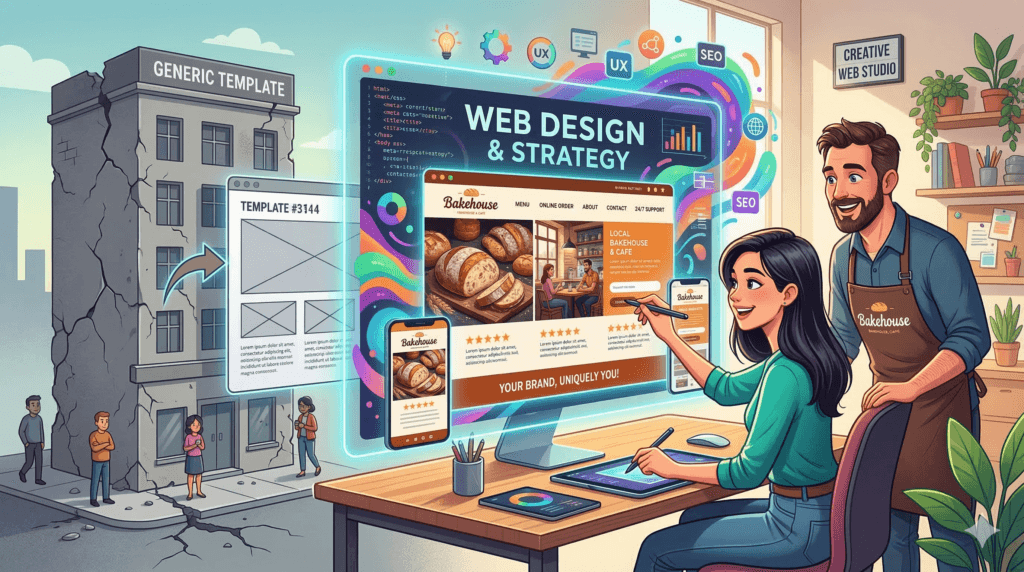
Let’s do a little mental exercise. Picture your physical storefront, your office, or perhaps even the way you package your products. You put immense thought into that, right? You want it to feel authentic. You want it to reflect the care you put into your work. You want it to be you.
Now, look at your website.
Does it feel like you? Or does it feel like a placeholder?
For many small businesses, the website is the last thing on the to-do list. Maybe you whipped up a quick template years ago just to get something online. Maybe you’re relying on a social media page. But if you’re serious about long-term growth and building a brand that lasts, “just getting something online” isn’t going to cut it anymore.
We live in a saturated digital world. Standing out requires intention. It requires more than just filling out a form on a generic website builder. It requires strategic, authentic web design.
Here is why investing in professional, custom web design is one of the most significant moves you can make for your small business.
The End of the “Digital Billboard” Era
For a long time, having a website was like having a static billboard on a digital highway. It was just there to confirm you existed. But in 2026, the internet is not a quiet road; it’s a bustling marketplace.
Your customers don’t just visit websites to find your phone number. They visit them to experience your brand.
A website is an active, living tool. It’s a mechanism for storytelling, connection, and, ultimately, conversion. When you use a generic template, you are trying to squeeze your unique story into a one-size-fits-all box. The results are often bland, confusing, or simply unmemorable.
A good web designer doesn’t start with code; they start by listening to your story. They capture your voice, your ethos, and your values, and translate them into a visual narrative. That is something a $10 template simply cannot do.
You Are Building Your Own House (Not Renting on Landlord’s Turf)
I see many incredible businesses relying solely on a Facebook page or an Instagram profile to act as their website. And while social media is fantastic for connection, it is a dangerous strategy to have it as your only digital home.
Why? Because you don’t own it.
- The Algorithm Shift: One day, your posts are reaching thousands. The next, the algorithm changes, and you’re screaming into the void. You are at the mercy of their system.
- The Content Lock-in: The traffic you generate on social media benefits the social media platform first. You cannot fully customize the user journey, own the data, or build a personalized email list in the same powerful way you can on your own site.
- The Design Limits: Your brand identity is reduced to a profile picture, a header, and whatever photo you posted today. There’s no space to craft a complete, immersive user experience (UX).
Your website is your property. You are building the house, you make the rules, and you are the landlord. You own the narrative, the data, and the relationship with your customers.
Small Business Marketing is About Specific Trust
Let’s talk about trust. As a small business, your greatest asset isn’t your massive budget; it’s your authenticity. It’s the fact that when a customer calls, they speak to you or someone who knows your name. It’s the human connection.
A high-quality website must radiate that trust immediately. And it does so through design choices:
- Original Photography: Skip the stock photos of people pointing at computers. Show the real faces of your team. Show your real workspace. Show the real products. Authentic, professional photos instantly humanize your brand.
- Strategic Typography and Color: Your choice of fonts and colors isn’t just aesthetic; it’s emotional. A financial planner might need calming blues and professional serifs; a funky café might need bright oranges and playful sans-serifs. Responsive web design means these details translate perfectly across desktops and smartphones.
- Thoughtful UX Design: Good design is intuitive. It guides the visitor exactly where they need to go, answering their questions before they even ask them. A chaotic, frustrating layout destroys trust and guarantees they will “bounce” back to Google.
Leveling Up Your Search Strategy (SEO)
We cannot talk about design without talking about how people find the design. That is where Search Engine Optimization (SEO) comes in, and the truth is, bad design hurts your SEO.
Search engines like Google are smarter than ever. They don’t just look at keywords in text; they analyze how users interact with your site.
- Page Load Speed: Google explicitly penalizes slow sites. Heavy, unoptimized designs are SEO poison.
- Mobile Experience: The majority of web traffic now comes from mobile devices. If your site isn’t perfectly optimized for smartphones (which many old templates are not), you will not rank well.
- Bounce Rate: If a user clicks your link and then immediately clicks “back” because the design is ugly or the navigation is confusing, that signals to Google that your site is not a helpful result. A good UX keeps users on the page.
Your website design is the literal foundation that your SEO strategy is built upon.
Key Questions to Ask About Your Current Web Design
Before you commit to a redesign or start building a new site, take a good, hard look at your current digital presence. Ask yourself:
- Does the first screen accurately tell visitors exactly what I do?
- Is it incredibly easy to find my phone number and address?
- Do I have at least three genuine customer reviews visible on the homepage?
- How long does it take for my homepage to load on my phone (using only cellular data)?
- Does the visual style (colors, fonts, layout) match the feeling of my physical business?
If the answer to any of these is “no” or “I don’t know,” it’s time to start thinking about an update.
The Bottom Line: Design is Not a Cost, It’s an Investment
When you look at a successful small business, you don’t just see a good product; you see a compelling story told through their brand. In 2026, the primary medium for telling that story is your website.
Professional, custom web design is not a luxury for the rich; it is an essential tool for the ambitious. It is the lifeblood of your digital marketing, your 24/7 salesperson, and the most trustworthy representation of your hard work.
Your business is unique. Your website should be, too. Don’t let your passion get lost in a generic template.